
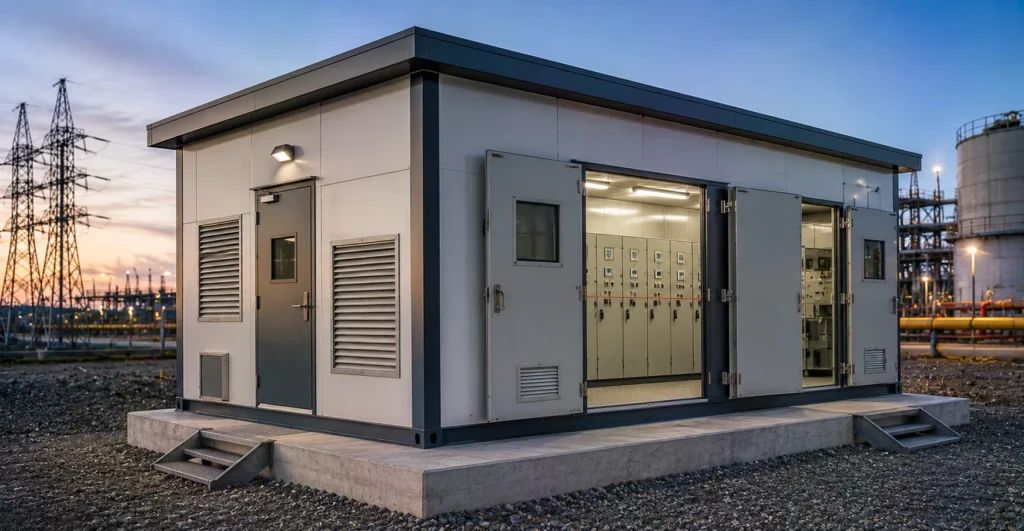
Mechwat designs, manufactures, supplies, exports and installs prefab ev charging station building for renewable energy applications where speed, reliability, technical detailing and long-term maintainability matter. Modular EV charging support building for charger control, metering, operator facilities and renewable-energy integrated mobility hubs. The product is positioned as a factory-built modular infrastructure asset, not only as a portable cabin, because its value comes from coordinated structure, MEP planning, site interface, documentation, safety provisions, logistics and installation readiness.
For global buyers, EPC contractors, government agencies, public infrastructure developers, hospitality groups, renewable-energy developers and CSR/ESG teams, Mechwat can support early-stage concept design, RFQ clarification, technical datasheet preparation, BOQ alignment, manufacturing, supply, export packing, site installation and commissioning coordination based on project-specific scope.
Energy & Climate Infrastructure: Renewable Energy
Energy and climate infrastructure requires robust, quickly deployable, safe and maintainable technical buildings. These projects often face remote locations, high temperature, dust, corrosion, electrical safety risks, commissioning pressure and uptime expectations.
Renewable-energy projects need fast commissioning, equipment protection and repeatable site infrastructure for solar, wind, storage and green mobility assets.
How Mechwat Adds Value
- Shortens project timelines by integrating structure, MEP, cable routing and equipment clearances before dispatch.
- Improves reliability for renewable energy, power grid and climate monitoring projects through standardized factory-controlled fabrication.
- Supports portfolio-wide repeatability for solar parks, wind farms, EV charging networks, grid substations and carbon/MRV assets.
- Reduces site civil work, weather dependency and installation risk for EPC contractors and asset owners.
Pressing Problems Solved by This Product
- Slow conventional civil construction and unpredictable site workmanship
- Difficulty coordinating structure, electrical, plumbing, HVAC, data and safety requirements under one RFQ
- High project disruption where public movement, site operations or commissioning deadlines cannot be disturbed
- Weak documentation, unclear datasheets and incomplete vendor comparison during procurement
- Need for manufacturer, supplier, exporter and installation partner with technical understanding of sector-specific use cases
Technical Product Architecture
- Segregated electrical, control, operator and customer-service zones
- Cable routing, earthing, ventilation and switchgear-interface planning
- Optional solar canopy, battery-storage interface and digital payment area
- Weather-resistant envelope for outdoor mobility infrastructure
- Scalable modular layout for future charger expansion
Application Areas
- Public EV charging hubs
- Fleet and depot charging stations
- Highway charging corridors
- Solar-powered charging campuses
- Commercial parking and smart mobility projects
Datasheet Technical Specifications
| Parameter | Indicative Specification / Design Consideration |
| Functional zones | Electrical/control room, operator cabin, customer service point and utility area |
| Structure | Steel modular frame with corrosion-protected finish |
| Electrical readiness | Cable trays, DB, metering space, earthing busbar, UPS and emergency shutdown interface |
| Ventilation/HVAC | Designed around equipment heat load and operator comfort |
| Fire safety | Detector, extinguisher/suppression interface, signage and emergency lighting provisions |
| Options | Solar PV interface, BESS room, canopy connection, IoT monitoring and CCTV |
| Design basis | Project-specific layout, wind/seismic/site loads, occupancy, utility interface and client technical specification |
| Manufacturing scope | Factory fabrication, finishing, MEP pre-integration and dispatch documentation as agreed in RFQ |
| Installation scope | Foundation interface, lifting, placement, anchoring, utility connection and commissioning support as per scope |
| Export readiness | Containerization, packing, documentation, dimensional coordination and destination-country compliance review where required |
Applicable Standards and Compliance Mapping
The following standards and references should be treated as a compliance-alignment map for website and RFQ communication. Final applicability depends on project country, authority, contract specification, risk category and certification requirement.
| Reference / Standard Area | Application to Product |
| IEC 60364 / IS 732 principles | Electrical installation safety, wiring, earthing, segregation, protection and commissioning interface. |
| IEC 61439 concepts where LV panels are integrated | LV switchgear assembly interface, clearances, panel access and verification expectations. |
| IEC 60529 / IP protection principles | Ingress protection strategy for dust, water, outdoor and equipment-room applications. |
| NBC India / local building and fire code | Building planning, fire/life safety, exit, ventilation and occupancy provisions. |
| ISO 9001, ISO 14001, ISO 45001-aligned execution | Quality, environment and occupational safety management expectations. |
| Structural design codes such as IS 800/IS 875/IS 1893 or equivalent | Structural frame, wind load, seismic consideration and foundation-interface design where applicable. |
| Material and coating specifications | Corrosion protection, paint/coating system, fire-rated or insulated panel selection and outdoor durability. |
| Client/EPC/authority approval documents | GAD, GA drawings, MEP drawings, load data, method statement, inspection plan and compliance matrix. |
RFQ Checklist for Buyer / Consultant / EPC
- Project location and destination country
- Quantity, module size and required delivery timeline
- Site layout, foundation type and access/cranage constraints
- Required drawings: GA, architectural, structural, electrical, plumbing, HVAC and installation method statement
- Utility availability: power, water, sewer, drainage, data, DG/UPS/solar backup
- Applicable authority approvals, client specifications, fire safety and inspection requirements
- Finish level, façade/branding, insulation, corrosion protection and environmental exposure conditions
- Charger type, quantity and kW rating
- Transformer, metering and switchgear scope
- Vehicle circulation and parking bay layout
- Battery storage or solar integration requirement
FAQ
Is Mechwat a manufacturer, supplier and exporter of this product?
Yes. Mechwat can position prefab ev charging station building as a manufactured, supplied, export-ready and installation-supported prefab product, subject to project scope, destination compliance and engineering approval.
Can the product be customized?
Yes. Layout, material, façade, insulation, electrical, plumbing, HVAC, furniture, safety, branding and monitoring options can be customized based on RFQ and site requirements.
Can Mechwat support installation?
Yes. Mechwat can support installation planning, method statements, foundation interface, lifting coordination and commissioning support depending on contract scope and project location.
Which standards apply?
Applicable standards depend on use case, country, site authority, fire/electrical risk, occupancy and client specification. A project-wise compliance matrix should be finalized before manufacturing.
What information is required for a quotation?
The buyer should share drawings, required size, quantity, location, utility details, approval requirements, finish level, delivery timeline and any applicable technical specifications.