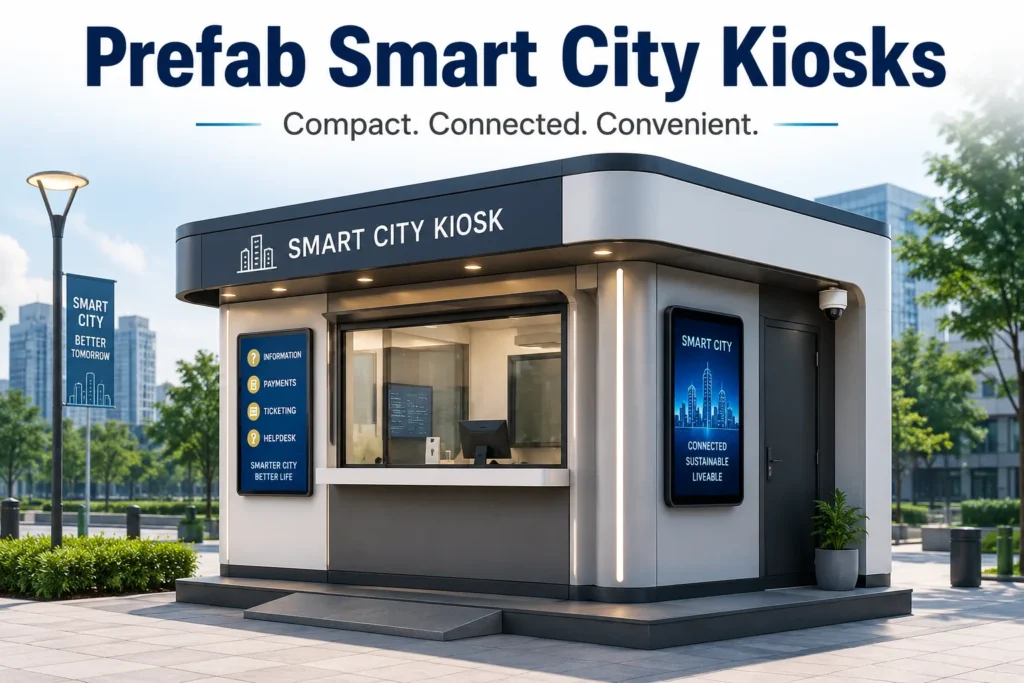
Mechwat designs, manufactures, supplies, exports and installs prefab smart city kiosks for smart city projects where speed, durability, compliance-readiness and professional execution are critical. Compact modular kiosk infrastructure for citizen services, information, payments and connected urban applications. The solution is developed as a factory-built, modular and project-specific infrastructure product that can be customized for site constraints, authority requirements, utility interfaces, public use, maintenance expectations and long-term operating conditions.
As a prefab engineering company with practical experience in sanitation, water systems, infrastructure and project execution, Mechwat positions this product not merely as a cabin or building, but as a complete project-ready asset: design support, material selection, structural frame, MEP integration, documentation, logistics, installation and commissioning support can be aligned under one RFQ-driven scope.
Urban Infrastructure: Smart City
Urban infrastructure projects need fast deployment, predictable quality, lower site disruption and public-facing durability. Prefab engineering allows city authorities, transport operators and EPC contractors to add essential facilities without long civil construction cycles, heavy wet-work, major traffic disturbance or inconsistent on-site workmanship.
Smart-city projects need visible public assets that combine modular construction, digital readiness, citizen services, environmental monitoring, branding and easy maintenance without creating new civil-work delays.
Mechwat’s smart-city prefab modules create small but high-impact nodes for services, monitoring, kiosks and public utilities, helping cities convert technology plans into installable infrastructure.
- Accelerates public infrastructure delivery where land availability, public movement and shutdown windows are limited.
- Improves standardization across multiple sites while allowing local customization for climate, footfall and authority approvals.
- Reduces site congestion, debris, labour exposure and public inconvenience compared with conventional construction.
- Supports cleaner, safer and more maintainable public assets through integrated MEP planning and factory quality checks.
How It Adds Value to Smart City Infrastructure
- Turns digital service concepts into installable public infrastructure nodes.
- Supports ticketing, information, payments, emergency helpdesk, surveillance and city branding use-cases.
- Can be deployed in parks, transit nodes, waterfronts, markets and civic zones with minimal civil work.
- Improves maintenance by standardizing structure, MEP, security, signage and equipment access.
Technical Product Description
The Prefab Smart City Kiosks is a prefabricated infrastructure module engineered around a corrosion-protected steel structure, modular wall and roof envelope, service-ready floor layout, factory-integrated MEP provisions and site-specific installation methodology. It can be delivered as a single module, multi-module block, containerized/knock-down configuration or integrated campus depending on transport limits, project phasing, foundation design and user load.
The technical design approach focuses on structural safety, utility integration, maintainability, installation speed, user comfort, climate resilience and approval readiness. Key interfaces such as electrical distribution, earthing, lighting, plumbing, HVAC, ventilation, fire detection, data, equipment mounting, cable routing, drainage and O&M access are planned during design rather than treated as late-stage site modifications.
For international buyers and EPC contractors, the product can be documented with a technical datasheet, GA drawing, material specification, finish schedule, inspection checklist, dispatch protocol, installation manual and RFQ compliance matrix. This improves procurement clarity and helps compare Mechwat’s prefab solution against conventional civil construction, container conversion and low-quality temporary cabins.
Key Applications
- Citizen service centers
- Tourist information kiosks
- Ticketing and payment counters
- Digital governance points
- Urban utility and help desks
Core Features and Benefits
- Compact, weather-resistant and brandable exterior design
- Power, data, display, POS and CCTV provisions
- Thermally comfortable operator space with ventilation/HVAC options
- Accessible counter design and queue-side interface
- Can be integrated with solar, IoT sensors and command-center connectivity
- Design, manufacturing, supply, export, installation and commissioning support can be structured as a turnkey scope.
- RFQ-ready documentation can be prepared for EPC, government, municipal, transport, industrial and international procurement teams.
Indicative Engineering Datasheet
| Parameter | Indicative Specification / Options |
| Typical layout | Operator counter, customer interface, storage and equipment wall |
| Structure | Light-gauge/MS frame with modular cladding |
| Envelope | Weatherproof panels, canopy and signage zone |
| Electrical/Data | DB, sockets, LAN/4G/5G router provision, UPS space |
| Security | Shutter, CCTV point, access control and lockable cabinets |
| Interior | Counter, cable raceway, seating and service access |
| Options | Digital display, solar roof, smart meter, environmental sensor package |
| Manufacturing scope | Factory fabrication, MEP pre-integration, finish installation, pre-dispatch inspection and packing as per agreed scope |
| Installation scope | Foundation interface, unloading, positioning, anchoring, joint sealing, utility connection support and commissioning checklist |
| Export readiness | Knock-down, modular or containerized dispatch planning; export packing and documentation subject to Incoterms and destination rules |
| Documentation | GA drawing, BOQ, datasheet, QAP, ITP, installation manual, O&M manual and warranty terms as agreed |
Applicable Standards and Compliance Mapping
The standards below are indicative references for specification writing and RFQ alignment. They should be confirmed against the final project country, local building authority, railway/metro/power/industrial owner specifications, statutory approvals, occupancy type and risk assessment. Avoid publishing certification claims unless a specific product variant or project has been certified.
| Standard / Code Area | Relevance to Product |
| NBC India 2016 / local building code | Building planning, fire and life safety, occupancy, accessibility, services and public-use provisions. |
| Local municipal / development authority rules | Site approval, drainage, road interface, public safety, signage, setback, water and sewer connectivity. |
| CPWD / PWD / client technical specifications | Civil, structural, waterproofing, flooring, cladding, plumbing, electrical and workmanship references. |
| Universal accessibility provisions | Ramp, grab bar, signage, movement clearance and inclusive public access wherever applicable. |
| ISO 9001 / ISO 14001 / ISO 45001 management-system alignment | Quality, environmental and occupational health-safety process expectations for manufacturing and project execution. |
| ISO 21930 / EN 15804-style product sustainability disclosure principles | Optional environmental product documentation, material transparency and life-cycle disclosure support where required by green procurement. |
RFQ Information Required from Client
- Project name, country, location and installation environment
- Buyer type: government, EPC, developer, railway/metro authority, industrial owner, reseller or export buyer
- Required quantity, delivery schedule, Incoterms/export requirement and installation responsibility
- Module size, layout, occupancy/user load and expected design life
- Permanent, semi-permanent or relocatable use requirement
- Applicable tender, code, owner specification and approval authority
- Site drawings, available footprint, access route, crane/unloading constraints and foundation inputs
- Wind speed, seismic zone, corrosion category, temperature, rainfall and site exposure conditions
- Utility availability: power, water, sewer/drainage, internet/data, backup power and earthing
- Required scope: concept design, detailed engineering, manufacturing, supply, export packing, transport, installation, commissioning, training and AMC
- Preferred materials, insulation, fire rating, acoustic rating, façade, colour, branding and interior finish level
- Required documents: datasheet, GA drawing, BOQ, QAP, inspection plan, compliance matrix, warranty and O&M manual
- Service function and equipment list
- Branding/signage requirements
- Connectivity type and backup power
- Expected public interaction and security level
Datasheet Submission Package
- Product technical datasheet with material and system options
- General arrangement drawing and floor plan
- Structural design basis and load assumptions
- MEP interface schedule: electrical, plumbing, HVAC, data, fire and utilities
- Bill of material and finish schedule
- Quality assurance plan, inspection and testing plan
- Factory acceptance checklist and dispatch documents
- Packing, transport and installation methodology
- Commissioning checklist and handover documents
- Operation and maintenance manual, warranty and AMC scope
FAQ
| Question | Answer |
| Is Mechwat a manufacturer, supplier and exporter for this product? | Yes. Mechwat can support design, manufacturing, supply, export coordination and installation planning for prefab smart city kiosks, subject to project scope and destination requirements. |
| Can Mechwat provide turnkey installation? | Yes. The scope can include concept design, detailed engineering, factory fabrication, transport, installation, commissioning support, documentation and O&M training. |
| Can the product be customized? | Yes. Dimensions, layout, finishes, façade, insulation, MEP systems, equipment interfaces, branding and compliance requirements can be customized project-wise. |
| Is the product suitable for global projects? | The product can be prepared for domestic or international procurement with export packing and project-specific compliance mapping. Local approvals must be confirmed in the destination country. |
| Can sustainability features be added? | Yes. Options include energy-efficient lighting, solar integration, water-saving fixtures, recyclable materials, low-maintenance finishes, environmental monitoring and lifecycle documentation where relevant. |